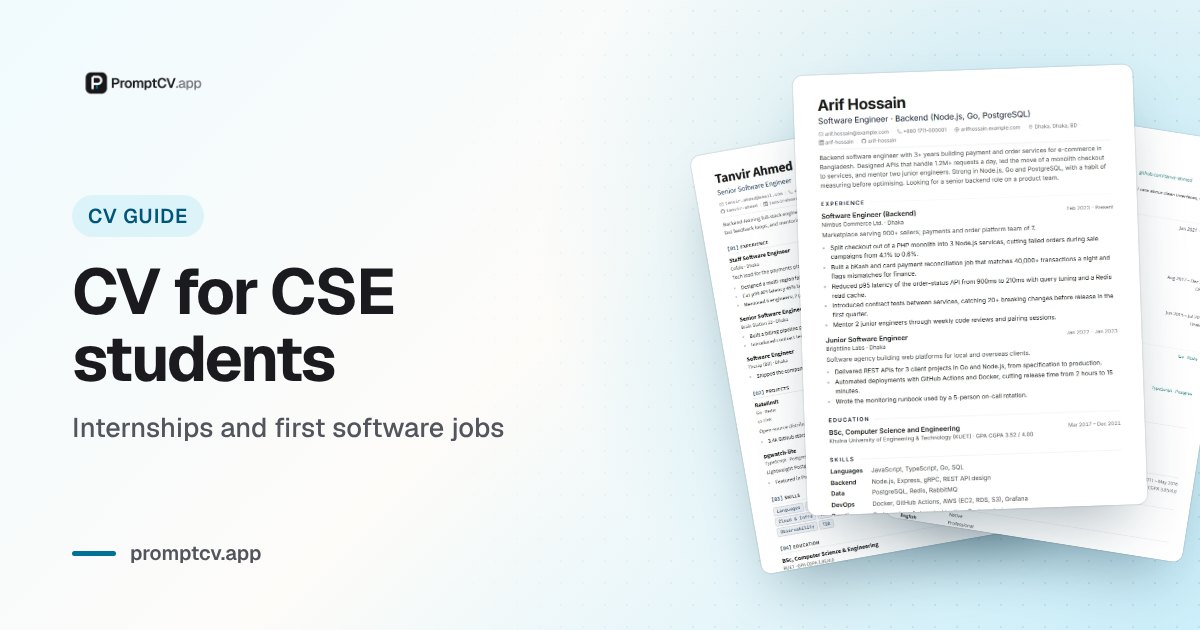
The CV reads from top to bottom — match what the reader needs first
Recruiters scan for different things depending on what you are applying to. Order your sections accordingly:
- Local SWE internship at Pathao / Foodi / ShopUp / Bkash: Education (CGPA), Skills, Projects, Contest record. Internships are typically a stretch goal so your academic signal matters most.
- Big-tech SWE internship (Google, Microsoft, Amazon, Meta APAC): Projects with measurable scale, Internships, Education (CGPA), Contest record. They optimize for impact and complexity over prestige.
- Foreign grad school (MS/PhD): Education, Research / publications, Projects, GRE / TOEFL scores, Letters of recommendation context. Different game entirely.
CGPA placement and how to handle low CGPA
Always state your CGPA. Hiding it gets you rejected faster than stating a low one.
- 3.7+: Top-line of the education section. Bold it.
- 3.3-3.69: State plainly. Pair with a strength: “Major CGPA: 3.85” if your major-track is higher than your overall.
- Below 3.3: Still include it. Add a one-line context if there is one (illness, family circumstance, full-time internship during semesters). Pair the education section with strong projects directly below.
Projects: what gets read, what gets skipped
Most students list 8-12 projects, which means recruiters read none of them. Pick 3-4 and go deep:
- Two technical depth projects. A compiler, a distributed system, a machine learning project with non-trivial training. Recruiters at competitive companies read these carefully.
- One scale or user project. Something with real users — a tool used by your batch, a Chrome extension with 500+ users, a Discord bot, an app published on the Play Store.
- One team / leadership project. SDP, capstone, BCB / IUPC team contribution, ACM-style problem set author.
For each project, write 3-4 lines:
- What it is (one line — “A distributed key-value store with tunable consistency”).
- Your role (lead / one of N / solo).
- Tech stack in plain text (not icons — those break parsers).
- Outcome with a number — “Handled 5,000 ops/sec on a 3-node cluster; paper submitted to BUET undergraduate research showcase 2025.”
Contest record: Codeforces, IUPC, ICPC, BCB
For SWE-track applications, a strong contest record is one of the highest-signal items on the CV. Format:
- Codeforces: Handle (linked), rating, max rating, color tier. e.g. “Candidate Master (max 2100, current 1980).”
- IUPC: Final rank and team name. “IUPC 2024 — Rank 4 / 180 teams (Team BUET-Cipher).”
- ICPC Regional / World Finals: If qualified, lead with this.
- BCB / BCC / Math Olympiad: Include if achieved, plain bullet.
If your max rating is below pupil (green / 1200), de-emphasize this section.
Internships and research positions
For each internship, write the format common in big-tech CVs:
- Company, role, location, dates.
- One-line about the team and product.
- 2-3 bullets of measurable outcomes.
Example:
Software Engineer Intern, Pathao Ride · Dhaka · Jun 2025 - Aug 2025
Driver onboarding team — built tooling for the 30-person ops crew.
- Built a bulk CSV import tool that replaced a manual onboarding flow taking ~12 min per driver; cut onboarding time to 90 seconds for batches.
- Reduced production error rate on bKash payout webhook handler from 3.2% to 0.4% by adding idempotency keys and structured retry logic.
Skills section: be specific
“Java, Python, C++” is too generic. Group by capability:
- Languages: C++ (competitive programming, ~5 years), Python (data science, web), TypeScript / JavaScript.
- Frameworks: React, Next.js, Express, FastAPI, PyTorch.
- Infrastructure: Postgres, Redis, Docker, AWS (Lambda, S3, EC2), basic Kubernetes.
- Tools: Git, Linux, Bash, GitHub Actions.
Mistakes I see most often in CSE-student CVs
- Two pages of project list without depth. Recruiters skim the first three and miss the rest. Cut down, go deep.
- Listing every CourseHub or Coursera course completed. Drop these. List one or two if directly relevant; otherwise, the time would have been better spent on a GitHub project.
- Icons everywhere. Hearts next to soft skills, language flags, framework logos. These break ATS parsing and look juvenile. Plain text wins.
- Photo of yourself coding. Skip. Use a passport-style photo if any, or omit entirely for tech CVs targeting multinational companies.
- “Looking for challenging opportunities to grow.” The most tired sentence in student CVs. Replace with what you specifically want next.
Final ordering for a typical BUET / IUT / NSU CSE student
- Header (name, contact, photo if BD-target)
- Objective (one tailored line per application)
- Education (with CGPA prominently placed)
- Internships (most recent first, 2-3 bullets each)
- Projects (3-4 deep, not 12 thin)
- Contest record (CF, IUPC, ICPC, BCB)
- Skills (grouped by capability)
- Co-curricular leadership (club president, hackathon org, etc.)
- Awards / scholarships
- References (two, for local BD applications)
Frequently asked questions
- Should I include my CGPA if it is low?
- Yes — recruiters expect it and will ask otherwise. Place your strongest projects first and add brief context for a low number.
- How many projects should I list?
- Two to four of your strongest, each with a one-line description and two to three outcome bullets. Clarity beats a long list.
- Do I put my Codeforces or online-judge rating?
- If it is competitive — a solid Codeforces rating or an ICPC/IUPC standing — yes, it is a strong signal for engineering roles. Skip it if the numbers are weak.
- One or two pages for a student CV?
- One page suits most freshers; two pages is fine once you have relevant internships, projects or research. Government and bank formats that ask for personal details often run to two.
- Where do I put my GitHub link?
- In your header alongside email and LinkedIn, and again next to each project. Make sure the linked repositories are public and presentable.