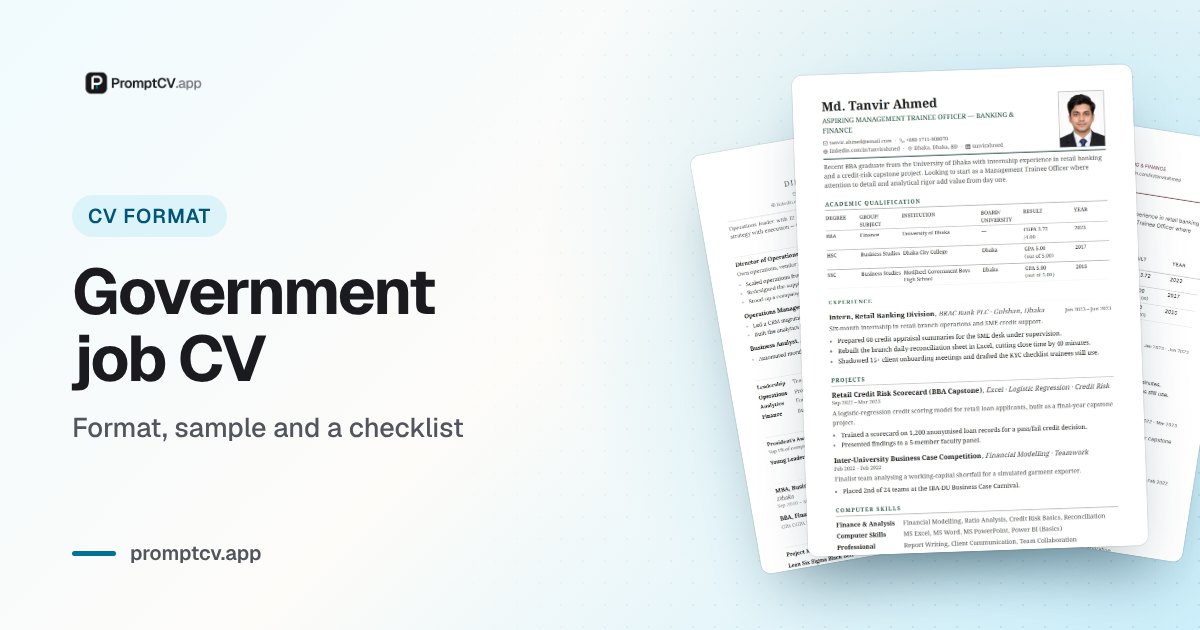
Government CVs play by different rules
Almost every "how to write a CV" article you find online is written for the private sector — a startup, an MNC, a Bdjobs-listed corporate role. That advice tells you to cut your CV to one page, drop your NID and date of birth, remove your photo, and never mention things like religion or your father's name. For a Grameenphone, BAT, or Brain Station 23 application, that is good advice.
Government hiring inverts almost all of it. A Bangladesh Public Service Commission (BPSC) recruitment, a ministry post, or a directorate vacancy is not a place to show personality or design flair. It is a document-verification exercise. The people processing your file are checking whether the facts you submitted are complete, internally consistent, and match your certificates and your National ID. Miss a required field and your application can be set aside before anyone reads a single line about your achievements.
So if you copied a sleek, one-page, MNC-style CV template into a government application, you are likely hurting yourself. What reads as clean and modern in the corporate world reads as incomplete to a government recruiter. Below is the format that actually fits how public-sector recruitment in Bangladesh works. If you also apply to private roles, keep a separate version and read The Bangladesh CV format guide for that market.
The application form is the real gatekeeper
Here is the single most important thing to understand: for most government jobs, your CV is not the primary document. The official application form is. BPSC runs its applications through an online portal (the BPSC form is submitted via Teletalk, with the fee paid using a Teletalk prepaid SIM), and most non-cadre ministry and directorate vacancies use a Teletalk-hosted form of the same kind. That form has fixed fields, a photo upload, a signature upload, and a fee-payment step. It is what gets logged, numbered, and shortlisted.
Your CV supports that form — it does not replace it. The recruiter reads the structured form first, and the CV or bio-data sheet is a backup they may glance at during document verification or the viva. That means two things. First, whatever you write on the CV must match the form exactly — same spelling of your name, same date of birth, same address. Second, filling the form carelessly is the fastest way to be rejected, so slow down and fill every field precisely as it appears on your certificates and NID.
Practical consequences of the form-first reality:
- Type your name in the exact form it takes on your SSC certificate and NID — including initials, spacing, and capitalisation. Do not "clean it up."
- Enter your date of birth exactly as printed on your SSC certificate. The certificate date — not your NID or your actual birthday if they differ — is usually treated as the official one for age eligibility.
- Check the age limit and its cut-off date in the circular and confirm you are within it before you pay the fee. Limits and any relaxation are set per circular, so read the exact text rather than assuming.
- Keep your Teletalk User ID and the confirmation SMS. You will need them to download your admit card later.
Fields a government CV keeps (that private CVs drop)
Modern private-sector advice strips a CV down to name, contact, experience, and skills. Government applications go the other way — they expect a full personal-information block. If you leave these out, your file looks incomplete. Include, typically:
- Full name — matching your SSC certificate and NID. If the form asks for a Bangla spelling too, provide it.
- Father's name and mother's name — both are standard on government forms and bio-data.
- Date of birth — as printed on the SSC certificate, and your age computed against the circular's cut-off date.
- National ID (NID) number — and Birth Registration number if the form asks for it.
- Present address and permanent address — both, in full, down to village/road, post office, upazila, and district. Home district often matters.
- Nationality (Bangladeshi by birth), and religion, gender, and marital status where the form asks.
- Quota, if a recognised one applies to you and to that circular — stated plainly, and only if you can document it.
- Contact — a mobile number and email you check daily, since admit cards and results are issued online.
None of this is optional decoration. A government file is expected to be a complete record of who you are, and the personal-information block is where completeness is judged first.
Education & results the government way
Private CVs often list only the highest degree. Government applications want the full academic ladder, from SSC upward, each with the details a verifier can check against your certificates. For every level — SSC, HSC, Bachelor/Honours, and Master's where applicable — record:
- The exam or degree name and the subject/group (Science, Commerce, Arts, or your major).
- The board or university (Dhaka, Rajshahi, Comilla, a Madrasah board, National University, or your public/private university).
- The passing year — the actual year of the result.
- The result — GPA/CGPA with the scale (for example GPA 5.00 out of 5.00, or CGPA 3.62 out of 4.00), or the Division/Class for older certificates.
The rule that matters most here is consistency. The passing years must run in a sensible order, the results must match what your certificates and mark sheets say to the decimal, and your date of birth on the SSC certificate must line up with the DOB you entered on the form. Verifiers cross-check these. A GPA that is off by a decimal or a passing year that does not match your certificate is the kind of small discrepancy that stalls a file at the verification stage.
Cadre vs non-cadre — how to frame yourself
In BCS, "cadre" posts are the administrative, police, foreign, tax, audit, education, health, and similar services; "non-cadre" covers the many other first- and second-class government posts filled from the same or related exams. The framing on your application differs slightly between them.
For BCS, the form asks you to rank your cadre choices in order of preference. Put genuine thought into that first and second choice — it influences where you can be placed, and you cannot casually change it later. Align the rest of your application with that preference: if you are aiming for an education or technical cadre, make your relevant degree, any teaching or research work, and subject expertise easy to see.
For non-cadre and departmental posts, tie yourself directly to the post's requirements as written in the circular. Two lines that carry real weight on government applications:
- Relevant experience and training — internships, project work, NGO or field experience, and any government/departmental training. Name the organisation, your role, and the dates.
- Computer literacy — a plain statement of your competence with word processing, spreadsheets, email, and Bangla/English typing, plus any certificate. Many non-cadre roles explicitly value this, so give it its own line rather than burying it.
Note that these roles rarely run your CV through automated software. Unlike a corporate vacancy, there is usually no keyword parser between you and the recruiter — a human reads the file. If you also apply in the private sector, that is a different game entirely; see how ATS screening works there so you do not confuse the two sets of rules.
Photo, signature, and attestation
Government forms are strict about the photo and signature, because they become part of your official record and your admit card. Expect three separate requirements.
- Photo — a recent passport-size colour photo, plain background, formal attire, taken within roughly the last few months. Online forms specify exact pixel dimensions and a file-size cap (often around a 300 × 300-pixel image under a small kilobyte limit), so read the upload instructions and match them.
- Signature — a scan of your handwritten signature, usually with its own size limits. Sign on white paper in dark ink and scan it cleanly.
- Attestation — for the printed copies you carry to the viva or document verification, photocopies of your certificates, mark sheets, NID, and photo are expected to be attested by a first-class gazetted officer. Get this done before the date, not on the morning of.
Keep a labelled folder — physical and digital — with your attested photocopies, originals for inspection, extra passport photos, your NID, and printouts of the form and admit card. Being able to produce a complete, attested set on request is part of what keeps your application moving.
Mistakes that get government applications rejected
Most rejections at this level are not about a weak candidate. They are about avoidable clerical errors that break the verification. Watch for these:
- Name or date of birth that does not match your certificates. A different spelling on the form versus the SSC certificate, or a DOB that disagrees with it, is the single most common disqualifier. Copy from the certificate, character by character.
- Missing or wrong attestation. Unattested photocopies, or attestation by someone not authorised to do it, can invalidate your documents at verification.
- Claiming a quota you cannot document. Only state a quota you genuinely qualify for under the current circular and can prove with papers. An unsupported claim is treated seriously.
- Incomplete address. Leaving out the permanent address, or giving a partial one, is a real reason files get flagged. Fill present and permanent address in full.
- Exceeding the form's limits. Oversized photos, wrong file formats, or text that overflows fixed fields cause the online form to reject the submission. Respect the stated dimensions and character limits.
- Paying the fee late or with the wrong SIM. No confirmed Teletalk payment means no valid application and no admit card, however good your qualifications are.
A government CV structure you can copy
When the circular asks for a CV or bio-data alongside the form, keep it plain, single-column, and complete — no graphics, no two-column sidebar, no colour blocks. A clean, formal layout is exactly what fits here; you can start from a clean, formal template and fill it in. Order the sections like this:
- Header — full name, post applied for, and the circular/advertisement number.
- Personal information — father's and mother's name, date of birth, NID, nationality, religion, present and permanent address, quota if applicable.
- Contact — mobile number and email.
- Educational qualifications — SSC upward, each with board/university, passing year, and result.
- Experience and training — relevant roles, internships, and courses with dates.
- Computer literacy and language — a plain competence line.
- Declaration and signature — a short truthfulness statement, date, and signature.
Then run this pre-submit checklist before you pay the fee:
- Name and date of birth match the SSC certificate exactly.
- NID number is correct and matches the form.
- Present and permanent addresses are both filled in full.
- Photo and signature meet the form's size and format rules.
- Every education row matches your certificate to the decimal.
- Any quota claim is one you can document.
- Attested photocopies are ready for the verification stage.
- The Teletalk fee is paid and you have saved the confirmation SMS.
Get these right and you clear the part of government recruitment that eliminates most people before merit is even considered — a complete, consistent, correctly documented application that gets processed the way the commission expects.
Frequently asked questions
- Is a photo required on a government job CV in Bangladesh?
- Yes. Government and public-sector applications expect a recent passport-size photo, and most official forms have a dedicated, attested photo box. Attach one even when you also submit a separate CV.
- Do I need my NID number and date of birth on a government CV?
- Yes. Unlike private-sector CVs, government applications require your NID number, date of birth matching your SSC certificate, father’s and mother’s name, and both present and permanent address.
- How many pages should a government job CV be?
- Two pages is normal and accepted. Government recruiters read the full record, so completeness matters more than the one-page rule used for private tech roles.
- Should I mention my quota?
- If you qualify for a recognised quota, state it clearly in the personal-information section, because it affects how your application is processed. Only claim a quota you can document.
- Should a government CV be in Bangla or English?
- Follow the official circular. Most BCS and many government forms accept English, but some departments use Bangla — match whatever the circular and application form use.
Keep reading
- ATS-friendly CV: will yours pass the screening?Why government forms and private-sector ATS screening are completely different games.
- The Bangladesh CV format guide (2026)Photo, NID, CGPA, references — the format rules for the local market.
- Cover letter format for Bangladesh (with samples)Pair your application with a forwarding letter that gets read.