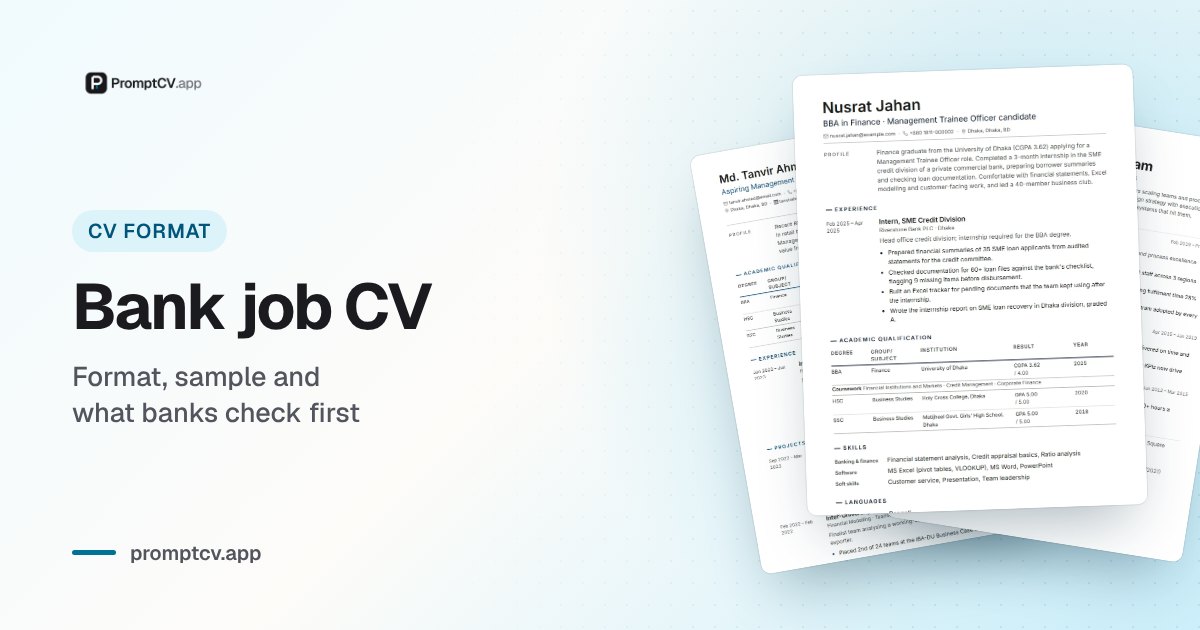
A bank job is one of the most competitive white-collar targets in Bangladesh, and the CV you send to BRAC Bank or Sonali Bank is judged against thousands of others by people who have seen every kind of padding. The good news is that banks screen for a fairly predictable set of things. Once you know what those are, you can build a CV that speaks directly to them instead of hoping a generic template does the job. This is not the same document you would send to a startup or a Bdjobs-listed corporate role — the emphasis is different, and getting the emphasis wrong is what quietly gets strong candidates cut.
What banks actually screen for
Before you touch the layout, understand the qualities a bank is trying to confirm from a sheet of paper. Nearly everything on a good bank CV maps back to one of these five signals:
- Numeracy. A bank runs on numbers, so it wants proof you are comfortable with them — strong results in quantitative subjects, and any evidence of working with data, reconciliation, or calculations.
- Integrity and reliability. You will handle cash and confidential information. A clean, consistent record with no unexplained gaps and honest claims reads as trustworthy; anything that looks inflated does the opposite.
- Communication. Bank staff face customers and write formal correspondence all day. Clear English, a well-organised CV, and any customer-facing experience all speak to this.
- Presentability. Front-line banking is a formal, client-facing job. A recent formal photo, a tidy single-column layout, and correct grammar signal that you fit that environment.
- Stability. Banks invest heavily in training, so they favour candidates who look likely to stay. A coherent career story beats a scattered one.
Attention to detail sits underneath all five. A single typo, a misaligned date, or a CGPA that does not match your transcript is read as carelessness — and carelessness is the one thing a bank cannot tolerate in someone who will move money. Treat proofreading as part of the job application, not an afterthought.
MTO / Probationary Officer vs general recruitment
Bank hiring in Bangladesh runs on two broad tracks, and your CV should be framed for the one you are applying to.
Management Trainee Officer (MTO) and Probationary Officer (PO) programs are the fast-track, officer-grade entry routes at private banks — the ones fresh graduates chase hardest. Competition is brutal and the bar on academics is high. Here the bank is hiring potential future managers, so it weighs your full academic record, leadership and extracurricular signals, internships, and any evidence of drive. Lead with a tight professional summary that names the track ("fresh finance graduate targeting a Management Trainee role"), then let strong results and relevant projects carry the page. These programs almost always involve a written test and multiple interview rounds, so the CV's job is to get you shortlisted for the exam.
General recruitment — Trainee Officer, Officer, cash officer, and experienced lateral roles — is more about fit for a specific function. If you are applying with experience, lead with what you have actually done: the products you handled, the volume you processed, the systems you used. A relationship officer with a real deposit-mobilisation record does not need to open with academics; the track record is the pitch. Match the CV to the exact role named in the circular rather than sending one generic version everywhere.
State-owned vs private banks
The two halves of the sector recruit in very different ways, and the document they expect differs with them.
State-owned banks — Sonali, Janata, Agrani, Rupali, and the specialised banks — hire largely through a centralised, exam-heavy, form-driven process. Recruitment for these is typically coordinated through Bangladesh Bank's Bankers' Selection Committee, with a common MCQ and written examination that shortlists candidates before any CV is read closely. In practice this means the application form and your eligibility (age, CGPA, no third division) are the real gatekeepers, and the CV or bio-data is a supporting document that must match your certificates exactly. Fill it plainly and completely — SSC upward, full personal details — and do not expect design to earn you anything.
Private banks — BRAC Bank, The City Bank, Eastern Bank (EBL), Dutch-Bangla Bank (DBBL), Prime Bank, and their peers — lean on the CV plus their own assessment. Many run applications through an online careers portal and an applicant-tracking system, so your CV has to be parseable by software before a human ever sees it. That is where a clean, single-column, standard-heading layout matters: fancy two-column templates can confuse the parser. If you are applying to a private bank online, it is worth taking two minutes to check it parses cleanly before you upload, and it helps to understand how ATS screening works so you do not lose on a formatting technicality.
CGPA and academic record — how to present
For bank jobs, academics are not a footnote — they are often an eligibility filter. Two realities you have to plan around:
First, the no-third-division rule. A very common line in bank circulars is that a candidate must have no third division or third class in any public examination — SSC, HSC, and degree level all count. Some circulars allow one third division across the whole record; many allow none. Read the exact wording before you apply, because this single line disqualifies more applicants than any interview does.
Second, the CGPA cut-off. For MTO and PO tracks at private banks, a CGPA in the 3.00–3.50 range on a 4.00 scale is a frequent expectation, and some competitive programs set it higher — but this varies by bank and by circular, so treat those figures as a guide, not a rule. State exactly what your transcript says.
Present your education as a clean block near the top (banks read it early), listing each level with the institution, board or university, passing year, and result with its scale — for example CGPA 3.62 out of 4.00 or GPA 5.00 out of 5.00. Do not round up, and make every number match your certificate to the decimal. If your results are strong, that is your headline; if they are modest but clear the eligibility line, present them plainly and let your skills and experience do the persuading. For the baseline format every local CV should follow, see the Bangladesh CV format guide.
Sections and order for a bank CV
Keep it one to two pages, single-column, and formal. A workable order for a bank CV in Bangladesh:
- Header — full name, phone, email, address, and a recent formal passport-size photo. The photo is standard here; use a plain background and business attire.
- Professional summary — two or three lines naming the role or track you want and your strongest, most relevant qualification. Skip it only if you are truly out of space.
- Education — placed high, since banks screen on it. Each level with institution, board/university, year, and result-with-scale.
- Experience — jobs, internships, and part-time roles, most recent first, each written as quantified results rather than duties.
- Skills — the banking-relevant ones below, kept honest.
- Certifications and training — Banking Diploma (DAIBB), CA/CC or CFA levels, Excel or analytics courses, with the awarding body and year.
- Extracurricular and references — leadership roles, clubs, and volunteer work that show communication and stability, plus "References available on request."
Skills that matter for banking
A skills section only helps if it lists what banks actually use. Drop the generic "hardworking team player" filler and name concrete, checkable competencies:
- Excel and spreadsheets. This is close to non-negotiable. Be specific — VLOOKUP, pivot tables, formulas for reconciliation — rather than writing "good at MS Office." Numeracy shows up here.
- Core banking software (CBS) familiarity. If you have touched a real system — Finacle, Oracle FLEXCUBE, Temenos T24, or an Islamic-banking platform like Ababil during an internship — name it. Even basic exposure is a genuine edge over a candidate with none.
- English proficiency. Banks correspond and report in English. If you have a test score or wrote reports in English, say so; otherwise let the CV's own clean English make the point.
- Customer handling. Any front-desk, sales, tuition, or service experience counts — it signals you can deal with clients calmly and professionally.
- Cash and compliance awareness. Familiarity with cash handling, KYC, and basic anti-money-laundering (AML) concepts is a real plus, especially for cash and general-banking roles. Mention it if it is true.
Turn duties into results: sample bullet rewrites
The difference between a forgettable CV and a shortlisted one is usually specificity. A duty describes your job title; a result describes your impact. Rewrite every line so it carries a number, a system, or an outcome. Four before-and-after pairs a banking applicant can adapt:
-
Before: Responsible for handling cash and customer transactions at the counter.
-
After: Processed 80–120 cash and clearing transactions a day at a busy branch counter with zero till discrepancies over six months.
-
Before: Worked on opening new accounts and selling banking products.
-
After: Opened 40+ new savings and DPS accounts a month and cross-sold debit cards, helping the branch meet its quarterly deposit-mobilisation target.
-
Before: Did an internship at a bank in the general banking department.
-
After: Completed a 3-month General Banking internship at The City Bank — handling account opening, cheque clearing, and remittance entries in Finacle, and submitting a report on DPS retention.
-
Before: Good at Microsoft Excel and data analysis.
-
After: Built a loan-portfolio tracking sheet for my final-year project in Excel using VLOOKUP and pivot tables, reconciling 500+ sample records.
Notice that each "after" line names a volume, a tool, or an outcome. You do not need to inflate anything — use the real numbers from your own work. Honest specifics beat vague grandeur, and a recruiter can picture you doing the job.
Pre-submit checklist
Before you upload or print, run down this list:
- The role or track from the circular is named on the CV, and the CV matches that role.
- You clear the eligibility line — no third division beyond what is allowed, and the CGPA cut-off is met.
- Every result matches your transcript to the decimal, with its scale stated.
- A recent, formal passport-size photo is attached, plain background, business attire.
- The layout is single-column and one to two pages, with standard section headings.
- Experience is written as quantified results, not a list of duties.
- Skills are specific and honest — Excel details, any CBS exposure, English, customer handling.
- Certifications list the awarding body and year (DAIBB, CA/CC, CFA, Excel).
- Contact details are correct and you check that email and number daily.
- Zero typos — read it aloud once, then have someone else read it.
- For an online portal, the file is a clean PDF that parses cleanly.
Get these right and your CV does the one thing it is meant to do at this stage: it gets read and keeps you in the pile for the written test and interview, where the rest of the selection happens. A bank cannot promise where you finish, but a clean, quantified, error-free application keeps you in the pile long enough to be judged on the things that actually matter.
Frequently asked questions
- What is the minimum CGPA for bank jobs in Bangladesh?
- Most private banks want no third division or class in any exam and a CGPA in the 3.00–3.50 range for MTO and PO tracks, but the exact cut-off varies by bank and circular. Always read the specific eligibility line.
- Is a photo needed on a bank CV?
- Yes. A recent, formal passport-size photo is standard on bank CVs in Bangladesh, matching the country’s general CV convention.
- How long should a bank job CV be?
- One to two pages. Keep it tight, quantified, and error-free — banks actively screen for attention to detail, so a clean two pages beats a padded one.
- Should I list professional certifications on a bank CV?
- Yes. Relevant certifications — Banking Diploma (DAIBB), CA/CC levels, CFA levels, advanced Excel — are strong signals for banking roles. List them with the awarding body and year.
- How do I apply for a bank job in Bangladesh?
- Most banks recruit through their own careers portal or a central recruitment site, plus Bdjobs listings. Keep your CV, photo, and certificates ready as clean PDFs and follow the exact steps in the circular.