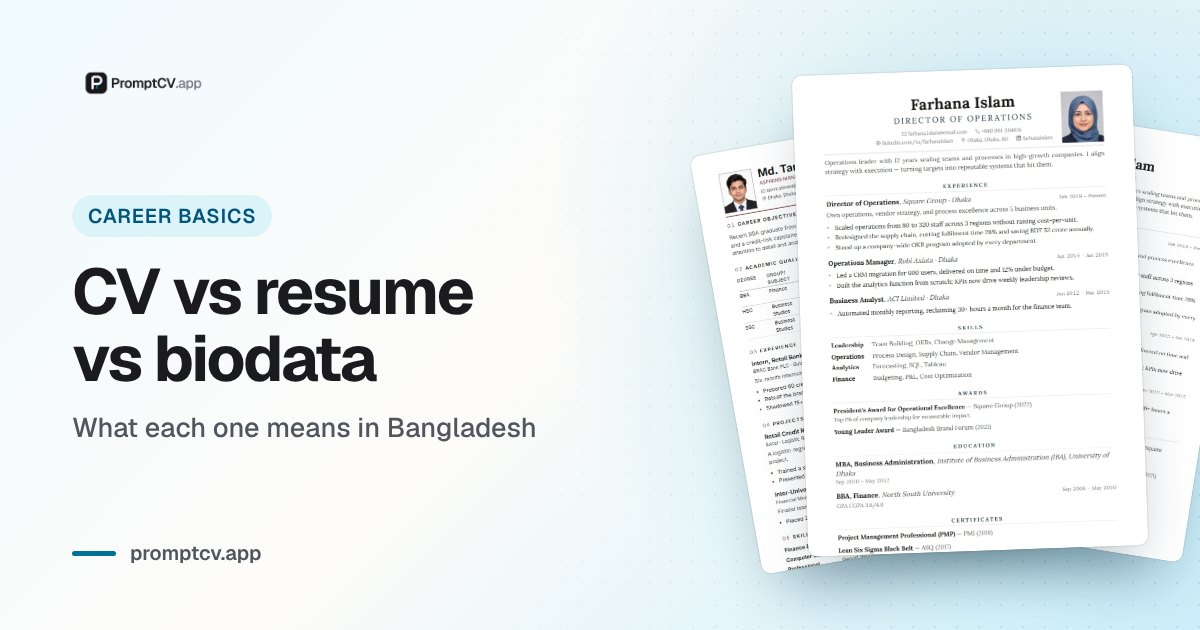
CV stands for curriculum vitae, Latin for "course of life": a document that sets out your education, work experience and skills for a job application.
Browse Bdjobs, ask a relative to review your application, or read a classified in the newspaper, and you will hear the same three words used to mean the same thing: CV, resume, and biodata. Most of the time it genuinely does not matter — when a Bangladeshi recruiter says "send your CV", they will happily accept a resume or a biodata and no one blinks. But the three words are not actually synonyms, and treating them as one causes a specific, avoidable mistake: sending a marriage-style biodata, or a bare data sheet, when the employer expected a proper job document. This guide untangles all three, explains why "CV" won in Bangladesh, and tells you exactly which one to send for government, private, MNC, overseas, and academic applications.
Quick answer
If you only have a minute, here is the difference in one line each:
- CV (curriculum vitae). The all-purpose job document — your education, experience, skills, and achievements, typically over about two pages. In Bangladesh this is the default, and it is what most employers mean whatever word they use.
- Resume. A shorter, sharper, targeted one-pager that keeps only what the specific role needs. You will mostly be asked for one by MNCs, global tech companies, and employers abroad.
- Biodata. A basic, factual data sheet — name, personal details, education, experience — that is more skeletal than a CV. A job biodata still turns up in some traditional and clerical applications; a marriage biodata is a completely different document and must never go to an employer.
When in doubt, send a CV. It is the word local employers use, the format they expect, and the one this whole site is built around. If you already know a CV is what you need, jump straight to the Bangladesh CV format guide for the exact layout.
What is a CV — and why "CV" dominates in Bangladesh
CV is short for curriculum vitae, Latin for "course of life". It is a structured summary of your professional life: a contact block, a short profile or objective, your education, your work experience, your skills, and often extras like references, language ability, or training. In Bangladesh a CV usually runs to around two pages for someone with a few years of experience — and, once a fresh graduate adds projects, internships, and extracurriculars, two pages is normal for freshers here too. A lean single page is what you tighten it into for an MNC or overseas role that asks for a resume, not the standard local CV.
Why does "CV" dominate here while Americans say "resume"? Because Bangladesh inherited its professional conventions from the British and wider Commonwealth world, where "CV" is simply the standard word for any job-application document. In the United States, "CV" means something narrower — a long academic record for professors and researchers — but that distinction never travelled here. So Bdjobs asks for your CV, university career offices run "CV writing" sessions, HR emails say "please attach your updated CV", and the roadside photocopy shop advertises "CV, one page, 10 taka". For nearly every job in the country, when someone says CV they mean your job document, full stop.
That makes the CV your safe default. If you only ever build one strong, well-formatted CV and keep it current, you are ready for the large majority of Bangladeshi openings. The one extra thing worth doing is making sure it is machine-readable, because many larger employers now screen applications with software before a human sees them — the ATS-friendly CV guide covers exactly how to make yours pass that screening.
What is a resume — and when BD employers actually ask for one
Resume comes from the French for "summary", and that is precisely what it is: a tighter, more selective version of a CV. Where a CV aims to be reasonably complete, a resume is ruthlessly targeted — usually one page, results-first, tailored to a single role, and stripped of anything that does not earn its place. A resume typically drops the photo, the date of birth, the father's and mother's names, and other personal details that a traditional local CV still includes.
In everyday Bangladeshi hiring, the difference is mostly academic — many people use "CV" and "resume" for the exact same file. Where it starts to matter is when an employer specifically asks for a "resume" and means it: multinationals such as Unilever, Nestlé, or British American Tobacco, global tech and product companies, foreign-owned firms, and remote roles for overseas clients. These employers are often working to international norms, and a lean one-page resume reads as more on-target to them than a two-page CV padded with personal fields.
The practical rule is simple. Keep one solid CV as your base. When a posting explicitly says "resume", or it is an MNC or overseas role, tighten that CV down to a single page: lead with achievements and numbers, cut the personal details, and keep only the experience that maps to the job. Whichever version you send, it should still be clean and machine-readable — the screening software does not care which word you used on top.
What is a biodata — job biodata vs marriage biodata
"Biodata" is short for "biographical data", and this is where the most expensive confusion in Bangladesh lives — because two completely different documents share the name.
A job biodata is a plain, factual data sheet. It lists your name, father's and mother's names, present and permanent address, date of birth, religion, marital status, and then your education and any experience — usually as a simple table or list, with little of the framing, profile, or achievement language a modern CV carries. It was the standard for clerical, traditional, and many government-adjacent applications for decades, and it still lingers in some rural, small-business, and older institutional contexts. It is not wrong, exactly — it is just more basic than a proper CV, and it is steadily being replaced by CVs even in the offices that once expected it. If a government form or circular asks for a "biodata", this factual job sheet is what it means; the government job CV format guide explains which of these fields those forms actually require.
A marriage biodata is an entirely different animal. It is the document families and matchmakers (ghotok) exchange for arranged marriages, and it focuses on family background, height, complexion, religious practice, siblings, family occupation, and partner expectations. It exists to answer a marriage question, not a hiring one — and it says almost nothing an employer wants to know.
Here is the mistake that costs people interviews. Someone searches "biodata format" online, downloads a template, and — because marriage biodatas massively outnumber job ones in local search results — ends up with a matchmaking sheet complete with a field for their guardian's expectations. They fill it in and email it to an employer. Even the milder version, sending a bare job biodata when the role clearly wanted a modern CV, makes an applicant look dated before anyone reads a word about their ability. Never send a marriage biodata for a job. If you are ever unsure what "biodata" means in a job context, treat it as a request for a clean, factual CV and you will be safe.
The real differences
Strip away the loose local usage and the three documents differ on four things that actually matter:
- Length. A resume is typically one page (occasionally two with real experience). A CV in Bangladesh is usually around two pages. A job biodata is often one to two pages of plain fields. Longer is not better in any of them — relevance beats length.
- Purpose. A resume is a targeted pitch for one specific role. A CV is a fuller professional record that can serve many roles. A job biodata is a record of facts for verification; a marriage biodata is not a job document at all.
- Content. Resumes lead with achievements and numbers and cut personal details. CVs balance experience, skills, and (in the local style) some personal fields. Biodatas are heavy on personal and factual fields and light on framing or accomplishment.
- Region and origin. "Resume" is the American default, "CV" the British and Commonwealth one Bangladesh adopted, and "biodata" a South Asian term still common across Bangladesh, India, and Pakistan.
Which one Bangladeshi employers want, by scenario
The honest answer to "which should I send?" is: it depends on who is hiring. Here is what fits each of the main situations you will actually face.
Government and public sector
For BCS, non-cadre, and most public-sector posts, the application form is the real document — a fixed set of fields you fill exactly as instructed, closer to a structured biodata than to a marketing CV. Completeness and accuracy matter far more than design, and details a private CV would drop (NID, date of birth, quota, father's name) are required here. Read the government job CV format guide before you apply, because the rules genuinely differ from private-sector advice.
Private companies and MNCs
For local private firms, a clean two-page CV is the expected default. For multinationals and global tech companies, lean toward a tighter, one-page resume-style document if the posting asks for a "resume" or reads to international norms. Banks are their own case — conservative, numbers-first, and detail-heavy — so the bank job CV guide is worth a look before you apply to one. For a customer-support or BPO role, the BPO CV guide shows the format those employers expect; engineering students from BUET, IUT, or NSU can follow the CSE student CV guide. Whatever you send, pair it with a short, tailored cover letter so the application does not arrive as a bare attachment.
Overseas and foreign employers
Applying abroad or to a foreign remote employer usually means a resume in the international style: one page, no photo, no date of birth or personal details, and achievements up front. Some European systems expect their own format (the Europass CV, for instance). The safe move is to follow whatever the posting specifies, and default to a lean, personal-details-free resume when it does not say.
Academia and scholarships
This is the one place the American sense of "CV" applies. Applications for higher study, research positions, or scholarships want a longer academic CV that includes publications, research experience, conferences, and academic references — the opposite of the one-page resume. Here, more relevant detail genuinely helps, so do not trim it down the way you would for a corporate role.
Build the right one fast
Once you know which document the situation calls for, you do not have to fight with margins in a word processor to produce it. You can build a clean, ATS-friendly CV, tighten it into a one-page resume for an MNC or overseas role, and keep it tailored per application from one base — then pay only when you download, with no subscription. Start from a professional template, fill in your details, and let the editor handle the formatting that recruiters (and their screening software) quietly judge.
The three words will keep getting used interchangeably around you, and that is fine. What matters is that you know the difference: send a proper CV for almost everything, a tighter resume when an MNC or overseas employer asks, a factual biodata only where a traditional form demands it — and a marriage biodata to exactly no employer, ever.
Frequently asked questions
- Is a CV and a resume the same in Bangladesh?
- In everyday Bangladeshi usage, "CV" is used for both, and most employers who say "send your CV" just mean your job document. Strictly, a resume is a shorter, targeted one-pager and a CV is longer — but locally the words are used interchangeably.
- What is a biodata for a job?
- A job biodata is a simple, factual data sheet — personal details, education, experience — once common for clerical and traditional applications. It is more basic than a modern CV and is slowly being replaced by proper CVs.
- Which is better, a CV or a resume?
- For Bangladesh, a well-structured CV is the safe default. Use a tighter resume-style one-pager when applying to MNCs, global tech companies, or roles abroad that specifically ask for a resume.
- Is a marriage biodata the same as a job biodata?
- No. A marriage biodata focuses on family and personal background for matchmaking; a job biodata or CV focuses on your education, skills, and work. Never send a marriage-style biodata for a job.
- How long should each one be?
- A resume is one page (sometimes two with experience), a CV is typically two pages in Bangladesh, and a biodata is one to two pages. Prioritise relevance over length.
Keep reading
- The Bangladesh CV format guide (2026)Once you know it is a CV you need, this is the format.
- ATS-friendly CV: will yours pass the screening?Make whichever document you send machine-readable.
- Cover letter format for Bangladesh (with samples)The letter that goes with it.
- Government job CV format (BCS & non-cadre)Government applications have their own rules.