No sign-up needed to edit. Building, editing and previewing are free; you pay only for the clean PDF.
Download this sample as a PDF (watermarked, free)
About this sample
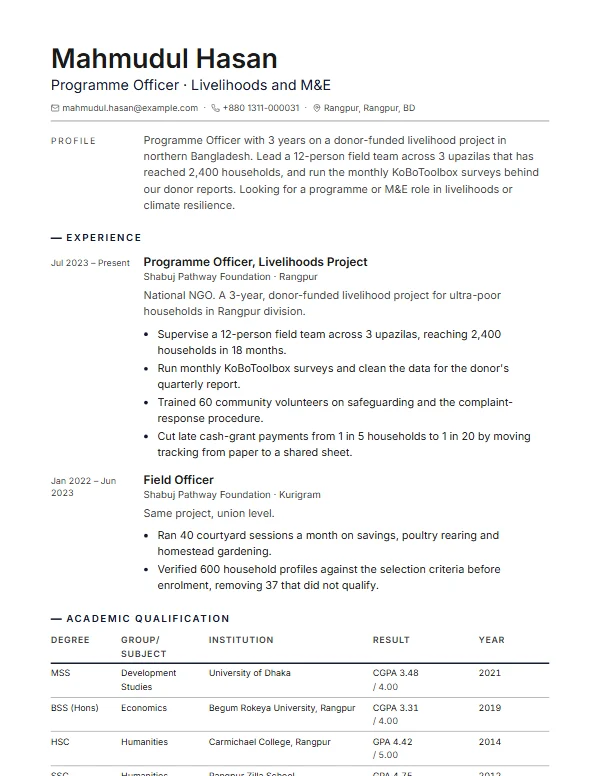
Development-sector jobs, from field officer to programme manager, are filled on evidence that you can deliver activities on the ground and report on them honestly. This sample shows both: a field team, the area covered and the households reached, and the monitoring and reporting work behind those numbers.
It describes the project by its sector, area and size rather than naming the donor, which keeps you clear of confidentiality questions. Large NGOs usually recruit through their own online application portals, then a written test and an interview, so keep a CV like this ready to copy from.
Full text of this sample
The sample above as plain text, section by section. Every name, employer and contact detail is fictional, and phone numbers are masked.
Mahmudul Hasan
Programme Officer · Livelihoods and M&E
Rangpur, Bangladesh · Contact: email, phone in the header
Summary
Programme Officer with 3 years on a donor-funded livelihood project in northern Bangladesh. Lead a 12-person field team across 3 upazilas that has reached 2,400 households, and run the monthly KoBoToolbox surveys behind our donor reports. Looking for a programme or M&E role in livelihoods or climate resilience.
Experience
Programme Officer, Livelihoods Project, Shabuj Pathway Foundation
Jul 2023 – Present · Rangpur
National NGO. A 3-year, donor-funded livelihood project for ultra-poor households in Rangpur division.
- Supervise a 12-person field team across 3 upazilas, reaching 2,400 households in 18 months.
- Run monthly KoBoToolbox surveys and clean the data for the donor's quarterly report.
- Trained 60 community volunteers on safeguarding and the complaint-response procedure.
- Cut late cash-grant payments from 1 in 5 households to 1 in 20 by moving tracking from paper to a shared sheet.
Field Officer, Shabuj Pathway Foundation
Jan 2022 – Jun 2023 · Kurigram
Same project, union level.
- Ran 40 courtyard sessions a month on savings, poultry rearing and homestead gardening.
- Verified 600 household profiles against the selection criteria before enrolment, removing 37 that did not qualify.
Education
- MSS in Development Studies, University of Dhaka, Jan 2020 – Jun 2021. CGPA 3.48 / 4.00
- BSS (Hons) in Economics, Begum Rokeya University, Rangpur, Jul 2015 – Dec 2019. CGPA 3.31 / 4.00
- HSC in Humanities, Carmichael College, Rangpur, Jul 2012 – Jun 2014. GPA 4.42 / 5.00
- SSC in Humanities, Rangpur Zilla School, Jan 2010 – Feb 2012. GPA 4.75 / 5.00
Skills
- Programme: Work plans and activity tracking, Community mobilisation, Beneficiary selection, Report writing
- M&E and data: KoBoToolbox, MS Excel (pivot tables), SPSS (basic), Logframe indicators
- Safeguarding: PSEA, Complaint and feedback mechanisms, Child protection basics
Certifications and training
- Protection from Sexual Exploitation and Abuse (PSEA), Online humanitarian learning course, Aug 2023
Languages
- Bengali: Native
- English: Fluent (reports and donor meetings)
References
- Rezaul Karim: Project Manager, Shabuj Pathway Foundation · rezaul.karim@example.com · +880 1XXX-XXXXXX
- Dr. Fahmida Rahman: Associate Professor, Department of Development Studies, University of Dhaka · fahmida.rahman@example.com
Personal details
- Father's name: Abdul Latif
- Mother's name: Monowara Begum
- Date of birth: 8 May 1997
- Nationality: Bangladeshi
- Permanent address: Village Pirgachha, Upazila Pirgachha, Rangpur
What recruiters check first
- Field experience with numbers. Upazilas or unions covered, households or participants reached, sessions run, team size. These numbers tell a recruiter the scale of work you can handle.
- Monitoring, evaluation and reporting. Data collection tools such as KoBoToolbox, indicators tracked against a logframe, and the progress or donor reports you wrote. Even junior posts are judged on accurate reporting.
- Safeguarding and accountability. Most NGOs now expect training in safeguarding and protection from sexual exploitation and abuse (PSEA), and some work on complaint and feedback systems. List the training and its year.
- Community skills and local knowledge. Running courtyard meetings, working with Union Parishads and local government, and knowing the area matter for field posts. Say exactly where you have worked.
- A clear sector. Livelihoods, WASH, health and nutrition, education, climate resilience or humanitarian response: name your sector in the summary so the CV reaches the right team.
Career objective and summary examples
Each one fits a different situation. Swap in your own employer, results and tools, and keep only numbers you can explain in an interview.
Programme officer, about 3 years
Programme Officer with 3 years on a donor-funded livelihood project in northern Bangladesh. Lead a 12-person field team across 3 upazilas that has reached 2,400 households, and run the monthly KoBoToolbox surveys behind our donor reports. Looking for a programme role in livelihoods or climate resilience.
Fresh graduate, no NGO experience yet
Development Studies graduate with a 2-month field internship at a national NGO, where I helped survey 300 households and wrote two case studies. Comfortable in Bangla and English, with Excel and KoBoToolbox, and ready for field-based work in any division. Looking for a Field Officer or Community Mobiliser post.
Monitoring and evaluation (M&E) officer
M&E officer with 4 years designing data collection for health and nutrition projects in Sylhet division. Built KoBoToolbox forms and Excel dashboards for 18 indicators, trained 25 enumerators and cut data-cleaning time per survey round from 10 days to 4. Looking for an M&E Officer or Specialist role.
Bullet points: weak vs strong
The same experience, written two ways. The strong version says what was done and what changed because of it. Only use numbers you can explain in an interview.
- Instead of: Worked with communities.
Write: Supervised a 12-person field team across 3 upazilas, reaching 2,400 households in 18 months. - Instead of: Collected data.
Write: Ran monthly KoBoToolbox surveys and cleaned the data for the donor's quarterly report. - Instead of: Gave training.
Write: Trained 60 community volunteers on safeguarding and the complaint-response procedure. - Instead of: Responsible for cash distribution.
Write: Cut late cash-grant payments from 1 in 5 households to 1 in 20 by moving tracking from paper to a shared sheet. - Instead of: Conducted meetings.
Write: Ran 40 courtyard sessions a month on savings, poultry rearing and homestead gardening. - Instead of: Selected beneficiaries.
Write: Verified 600 household profiles against the selection criteria before enrolment, removing 37 that did not qualify.
Skills to include
List the skills the job circular asks for that you really have, in its own words, grouped so a recruiter can scan them in seconds:
- Programme: Work plans and activity tracking, Community mobilisation, Beneficiary selection, Report writing
- M&E and data: KoBoToolbox, MS Excel (pivot tables), SPSS (basic), Logframe indicators
- Safeguarding: PSEA, Complaint and feedback mechanisms, Child protection basics
Format tips
- Describe each project by sector, area, size and length; you do not need to name the donor.
- Put a number in every field bullet: upazilas, households, sessions, team size.
- Name the data tools you have really used (KoBoToolbox, Excel, SPSS) and the reports you wrote.
- Keep personal details to what the circular asks; many NGOs collect them on their own form. Start at SSC; leave out JSC/PSC.
- Two pages is normal once you have several projects or postings.
Frequently asked questions
- What CV format do NGOs in Bangladesh want?
- A clear CV of up to two pages: contact details, a summary naming your sector, experience with numbers, education, training (including safeguarding), skills and two referees. Most large NGOs then ask you to apply on their own online form, so keep the CV text ready to copy from.
- How do I describe donor projects without breaking confidentiality?
- Describe the project by sector, area, size and length, for example "a 3-year livelihood project for ultra-poor households in Rangpur division", and give your own results. Leave out internal budgets, participant names and anything marked confidential.
- How do I write a career summary for a large NGO job?
- In two or three lines, name the role you want, your sector, your strongest field result with a number and the tools you use. Start from the examples above and change them for each circular.
- Can I write an NGO CV with no experience?
- Yes. Lead with your degree, then field internships, thesis fieldwork, volunteering with youth or relief groups and any surveys you helped run, each with a number. Field Officer and Community Mobiliser posts often hire fresh graduates.
- Does an NGO CV need a photo?
- Many Bangladeshi NGOs ask for one, often on their own application form, while international organisations often prefer none. Follow the circular. If you add one, use a recent photo (last 6 months).